Background
Background
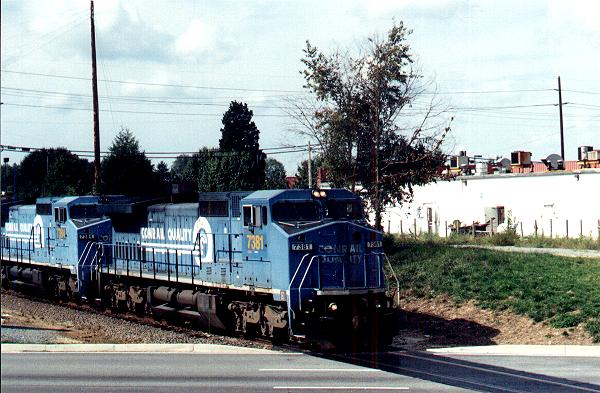
CSXT Dash 8-40CW #7381 leads a northbound lite power move through the Mattawoman Beantown Rd. crossing in Waldorf, MD.
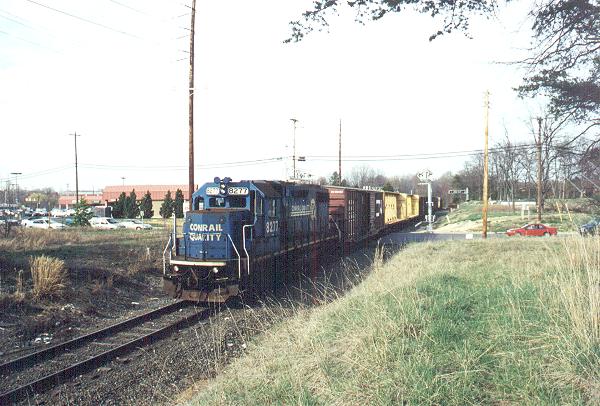
CR GP38-2 #8277 is on the rear of the local as it passes the Substation Rd. crossing in Waldorf, MD.
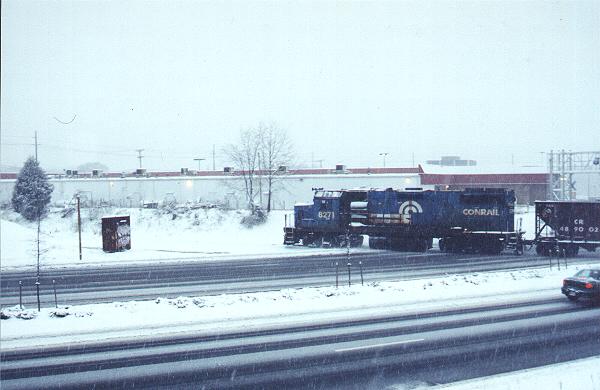
CR GP38-2 #8271 leads the southbound local through Waldorf, MD on a snowy day in March. |
The Pope's Creek Secondary northern terminus
is it's connection with Amtrak's Northeast Corridor at Bowie, MD.
There is a wye which allows trains to come and go to both Bayview Yard
in Baltimore and Benning Yard in Washington DC with out any turning of
locomotives. A speed indicator device is in service between MP 10
and MP 11 because trains accessing the south leg of the wye at Bowie are
restricted to 10 MPH. A Defect Equipment Detector (DED) is in service
at MP 7.9 to check trains for problems before they access the Northeast
Corridor (NEC).
Sidings are located at Collington (5200 ft), Marlboro (600 ft), Wine (4600 ft), and La Plata (400 ft). The sidings at Collington and Wine are commonly used to store empty hopper cars. This is done because CSX is limited to 160 cars on the NEC and on certain occasions empties may be over that tally. They are placed there until a train with less then 160 can pick them up for travel to Benning Yard. The sidings at Marlboro and La Plata are commonly used for team tracks for industries who do not have their own spur for loading and unloading. The wye at Brandywine located between MP 24.6 and MP 24.9 is the connection between the Pope's Creek Secondary and the Herbert Secondary. There is no local business along the Herbert Secondary. Lastly, Indian Head Junction is the connection to NAVY owned trackage that leads to the Indian Head Naval Base. Currently, this trackage is going to be used for a dinner train run by the Northern Central Railway. The option remains viable for freight traffic to also operate along this portion of track. All radio communications are carried out on frequency 161.070 with the Trenton Line Dispatcher. |
Current Operations
Coal
| CSX currently operates two loaded coal trains (southbound) and two empty hopper trains (northbound) a day plus a twice-a-week local. All traffic originates in Benning Yard in Washington DC. The loaded coal trains operate to the Chalk Point Generating Plant located on the Herbert Secondary and to the Morgantown Generating Plant at the end of the Popes Creek Secondary and are both operated by PEPCO. Empty hopper trains return from these locations on a daily basis. These coal trains usually have three 4,000 HP units for power equipped with LSL speed limiters for use on Amtrak's Northeast Corridor. Non-LSL units such as CSX SD70MACs and AC44CWs have been appearing recently as middle units. | 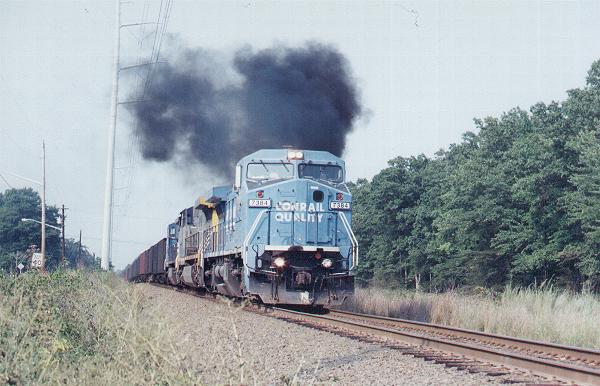
CSXT Dash 8-40CW #7384 smokes it up with a southbound coal drag at the Brandywine Wye in Brandywine, MD.
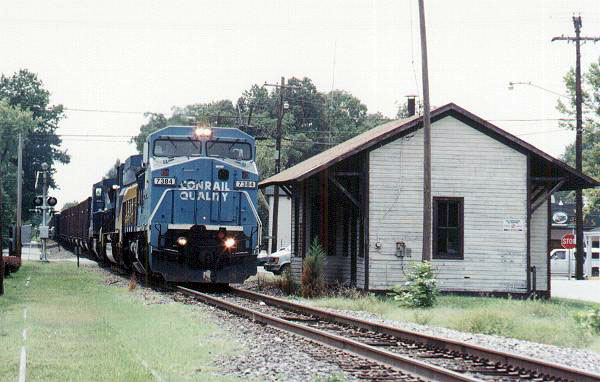
CSXT Dash 8-40CW #7384 leads a northbound empty hopper train through La Plata, MD pass the long forgotten depot. |
Local
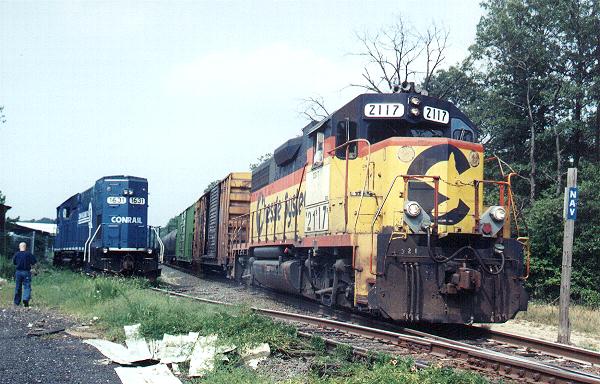
CSXT GP38 #2117 still in Chessie Paint switches box cars full of lumber at a distributor in White Plains, MD along with CR GP15-1 #1631. |
More interesting operations revolve around the local. The local is suppose to have two LSL-equipped GP15-1s of Conrail lineage. This is not true for most of the time. I have witnessed numerous six-axel units in local freight service along with non-LSL equipped four-axels. On one occasion, a CSX GP38 in Chessie Colors appeared in local service. It was the first true CSX unit to shine the rails of the Popes Creek. |
| The irregular customer that the local serves is a small plywood distributorship located in a small industrial park. This industry may only receive two to three cars a month. On a normal day, the local will just run past this location without stopping. | 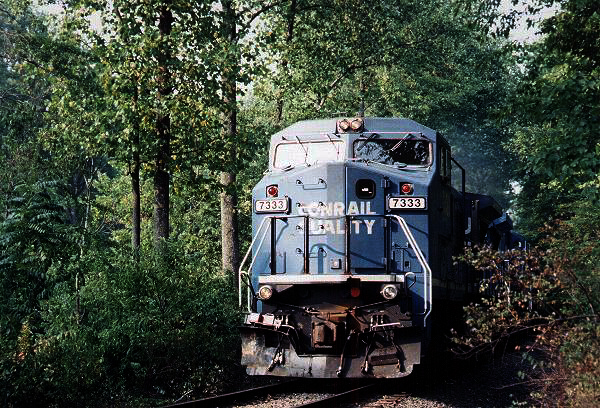
CSXT Dash 8-40CW #7333 leads southbound empties past the Cedarville Rd. crossing in Waldorf, MD. |
| The local serves three regular customers and one other customer on an irregular basis. As the local arrives in Waldorf, MD, home of the four customers, it proceeds to the 84 Lumber yard just south of the limits of Waldorf. The local will first pick up any empty box or center-beam cars and pull them on to the main. It will couple to the loaded cars and push them into the spur and drop them at the appropriate locations. After the switching of the lumber yard is complete the crew will perform some minor switching to arrange locomotives for switching at the other customers. This involves dropping one engine on to the spur of the lumber yard. The other engine will couple to the remaining cars and pull them forward. After they clear the switch they will then push the cars and engine on to the lead and couple to the engine. They then pull forward and lock the switch to the lumber yard. The local now appears to be a push-pull train. After performing the required break test they proceed north into Waldorf for the other customers. |
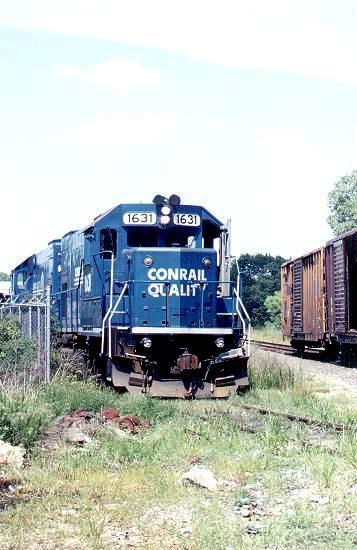
CR GP15-1 #1631 pulls out of the lead to the 84 Lumber yard in White Plains, MD. |
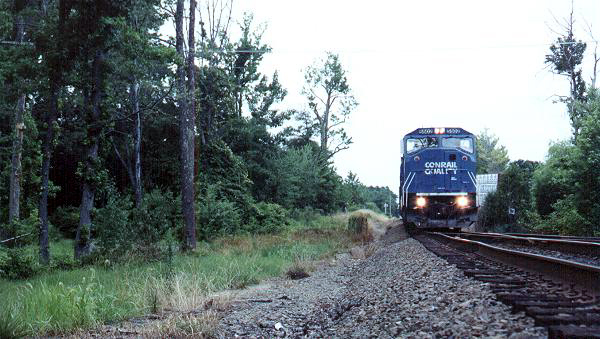
CR SD60M #5502 prepares to couple on to empty lumber cars from Chopp Lumber in Waldorf, MD.
|
In Waldorf, MD, the local serves two customers along the Pika Drive Industrial Park. They are Chopp Lumber and a large ink distributorship. On a normal day, they will serve Chopp Lumber first. This is an easy job to do because all it requires is pulling out the empties and pushing in the loads. There are no special requirements for the spotting of the cars. The ink distributor on the other hand is extremely complicated to switch. Not all of the cars present at the industry are ready to leave on that particular day. The empties and loads are intermingled amongst each other which makes the job of the conductor more hectic. After the switching of the ink distributor is done, the crew couples all the empties from all of the industries together, performs the required FRA break test, and leaves northward for Benning Yard in DC. |
Miscellaneous Items
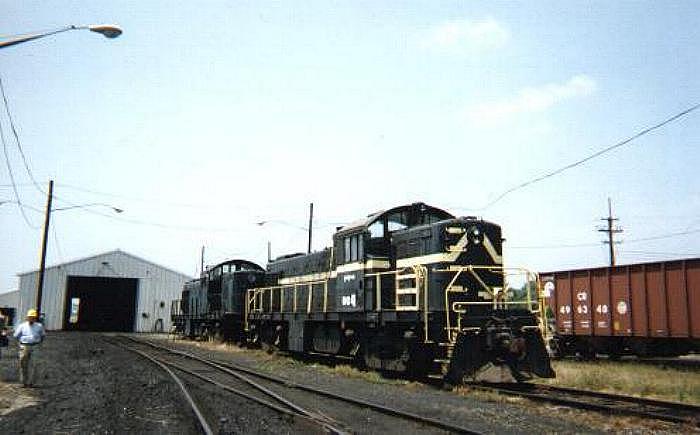
| In current operation at the Morgantown Generating
Plant are two operable ALCO RS1s. These are the oldest operating
diesel locomotives in the state of Maryland and the second oldest operationg
locomotive in general behind steam engine WM #734 operated by the Western
Maryalnd Scenic RR in Cumberland, MD. There is a thrid RS1, but it
is being taken apart for extra parts to keep the other two running.
Also operating from Indian Head, MD to White Plains, MD is the Route of the Blue Heron Dinner Train operated by the Northern Central Railway. Power for the train is suppost to be two former MBTA FP10s but at the time of this writing they have not arrived. This train operates over the NAVY owned trackage. There is the possibility of this line to transport coal to the Indian Head Naval Base power plant. This traffic would be interchanged with CSX at White Plains, MD. |
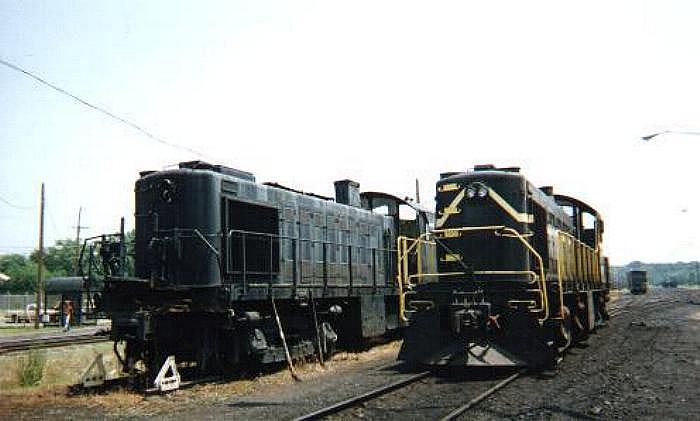
PEPCO RS1 #3 moves to collect a scale test car to determine the accuracy of the scales at the plant in Newburg, MD.
|
|
|
|
Back to CSX Railfans: November 1999